
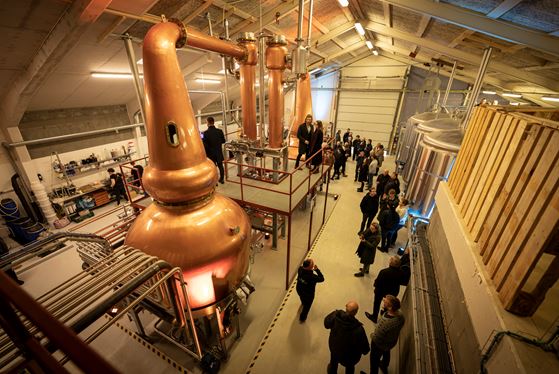
The challenge was: could a distinct Faroese terroir be captured in a whisky? The team had built up a wishlist of flavour notes such as rock, ocean and grass that defined Faroese cuisine.
Building on Scottish knowhow and traditions - the distillery was designed by Scottish engineers, the copper stills are from Speyside Copper Works, the malt is Scottish, and their main flavour consultant on the new make recipe is Scottish - the desired whisky profile was and is significantly different. Then there is the maturation regime.
A range of casks are used, no news story in that. But the design of the warehouses is, in whisky terms, radical but built on the historic traditions of "hjallur” warehouses. The distinctive slatted storehouses that have been used for centuries in the islands to cure and ferment foodstuffs. The slatting exposes the casks to the extreme climate on the islands. Winds blow directly into the warehouses off the ocean and over the casks. Rain, too, has its impact, giving a distinctly humid environment. Then there is the decidedly cool temperature ranging from 2°C during the mild winters, to 12°C in cool summers.
All this plays its part in shaping the whisky and creating a true sense of place.