
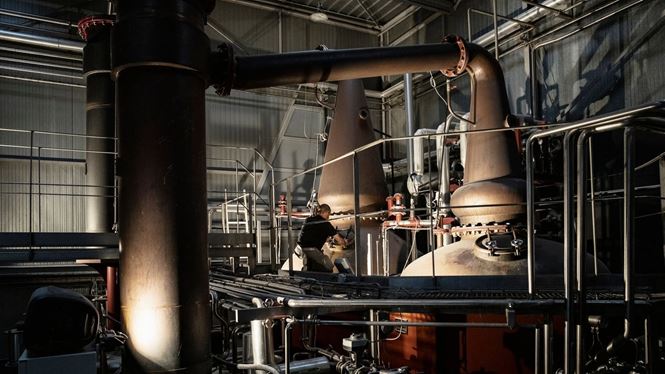
Across the Channel, the French are among the world’s most passionate and committed drinkers of whisky. Perhaps it is an echo of the Auld Alliance which sees such a healthy trade and appreciation of aged barley eau-de-vie between Scotland and France. It can be no shock, if perhaps a little surprising, to find a group of distillers working across the country creating whisky.
Often these have a distinctive local and French accent. Frédéric Revol at Domaine des Hautes Glaces has pioneered using some more unusual grains paired with distinctly French Alembic stills. Dr Magali Picard at Maison Lineti deploys winemaking techniques like long fermentations in ovoid concrete eggs, co-inoculation, malolactic fermentation and lees stirring. At La Piautre in the Loire they have a strong belief in terroir and tradition and Armorik from Brittany has a fiercely Breton character.
Made at the Warenghem distillery in Brittany, Armorik was the first French single malt reaching the market in 1998. The distillery itself is older with a history stretching back to 1900, but it was only in the later stages of the 20th century that whisky began to flow from the pot stills. Now with decades of experience, and stock, we are seeing the cementing of a core range which makes thoughtful use of new oak, ex-bourbon and sherry casks. There is even a peated expression full of iodine and herbal smoke.
Familiar to visitors to the show, Domaine Des Hautes Glaces was founded by Frédéric Revol in 2009 in the French Alps. The intention was for a grain to glass farm distillery with a focus on terroir and sustainable practice. That’s reflected in a commitment to organic production, regenerative agriculture, locally sourced renewable energy and eco-friendly decisions around lighter and recycled packaging. For all that admirable green agenda, perhaps of greater interest to whisky drinkers is how these whiskies taste. Serge Valentin of Whisky.Fun gave their Epistémè R18P23 a score of 91, saying it "demonstrated extraordinary qualities and truly innovative ideas."
In a story that’s faintly familiar, La Piautre began as a brewery in 2004 in deepest, darkest wine country in the middle Loire near Angers. While barley was grown and available locally, there weren’t any maltsters and so inevitably, the team turned their hand to transforming humble barley into the miracle that is malt.
They do this in the traditional way of floor malting and, a nice touch this, dry the malt using wood chips sourced from local forests. Once they had a malt house up and running, the team turned their mind to distilling and to whisky, with their first whisky released in 2017. They have a pair of Charentaise stills which are direct-fired by wood. As maltsters, they have more options and control over their raw materials, which sees them experiment with different woods for drying, peat and then, based as they are in the Loire valley, experimenting with a whole host of casks. That includes ex-wine, and they have plenty to pick and choose from, ex-cognac, and different sources of French oak.
Based in the epicentre of French winemaking, Bordeaux, Maison Lineti’s approach to whisky making makes full use of all the knowledge and techniques, expertise and equipment that the region’s oenologists have. This sees Dr Magali use seven concrete eggs to ferment the wort. These are a relatively common sight now in wineries, with ambitious winemakers using these dramatic pieces of equipment to encourage the most dynamic ferments possible. Nor does the winemaking influence stop there; Magali isn’t afraid to use malolactic fermentation, lees stirring and other techniques to bring out even more flavour in the wort.
The long-term aim is for vintage releases, following single years on a journey through the cask, charting its maturation and development through the years.